
Introduction
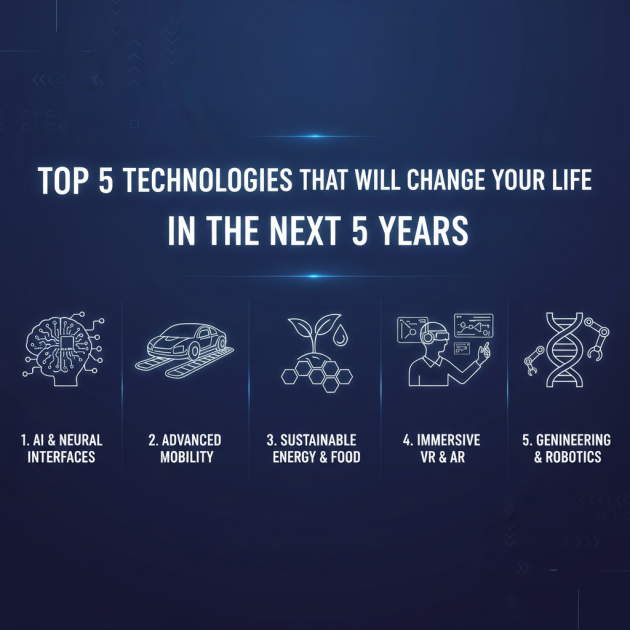
As we step into a new era of innovation, several technologies are poised to reshape our lives over the next five years. These advancements promise to enhance efficiency, improve health, and create a more sustainable world. Here, we explore the top five technologies that will significantly impact our everyday experiences.
1. Artificial Intelligence (AI)
Artificial intelligence is not just a buzzword; it's a transformative technology that is rapidly evolving. With machine learning and deep learning, AI is becoming more sophisticated and capable of performing tasks that were once thought to be the sole domain of humans.
- Personal Assistants: AI-driven personal assistants will become more intuitive, managing schedules, setting reminders, and even providing emotional support.
- Healthcare: AI will revolutionize diagnostics, personalizing treatments, and enabling predictive healthcare solutions that can foresee and prevent illnesses.
- Automation: From self-driving cars to automated customer service, AI will streamline everyday tasks, making life more efficient.
2. Augmented Reality (AR) and Virtual Reality (VR)
AR and VR technologies are set to create immersive experiences that blend the digital and physical worlds. These innovations will change how we communicate, shop, and learn.
- Education: AR and VR will enable interactive learning experiences, allowing students to explore complex subjects through immersive simulations.
- Retail: Imagine trying on clothes virtually or seeing how furniture fits in your home before making a purchase. AR will make shopping more engaging and convenient.
- Social Interaction: VR will transform social media, enabling users to interact in virtual environments, making online interactions feel more personal.
3. Renewable Energy Technologies
As the world increasingly focuses on sustainability, renewable energy technologies are set to change how we consume and generate power. Innovations in solar, wind, and battery storage will have a profound impact on our lives.
- Solar Energy: Advances in solar panel efficiency and affordability will make solar energy accessible to more households, reducing energy bills and carbon footprints.
- Energy Storage: Improved battery technologies will allow for better energy storage solutions, making renewable energy a more reliable option.
- Smart Grids: Intelligent energy grids will facilitate the efficient distribution of energy, optimizing consumption and reducing waste.
4. Biotechnology
Biotechnology is set to revolutionize healthcare and agriculture. With advancements in genetic engineering and personalized medicine, our approach to health and food production will transform.
- Personalized Medicine: Tailored healthcare solutions based on individual genetic profiles will enhance treatment effectiveness and minimize side effects.
- CRISPR Technology: The ability to edit genes will open new doors for curing genetic diseases and improving crop resilience.
- Food Production: Biotech innovations will lead to sustainable farming practices that increase yield while reducing environmental impact.
5. Quantum Computing
Quantum computing, though still in its infancy, holds the potential to revolutionize industries by solving complex problems at unprecedented speeds. This technology will impact fields ranging from cryptography to drug discovery.
- Complex Problem Solving: Quantum computers could analyze vast datasets, leading to breakthroughs in science, finance, and logistics.
- Security: Enhanced computing power will lead to more secure data encryption methods, safeguarding information in the digital age.
- Innovation Acceleration: Rapid simulations and calculations will facilitate advancements in various sectors, speeding up the pace of innovation.
Conclusion
The next five years promise to be exciting as these technologies reshape our lives. By embracing these innovations, we can look forward to a future that is more efficient, sustainable, and connected. Staying informed and adaptable will be key as we navigate this transformative landscape.